Magnetic or bracket-mount? How a wireless towing camera helps you reverse and change lanes with a caravan, what it costs, and renting one with your Kampi booking.
Hook up a caravan and the rear-view mirror becomes a picture of the caravan's front wall. Everything behind it is guesswork. The side mirrors show you the lanes on either side, but not the bakkie sitting two metres off your back bumper, the child on a bicycle behind you at the campsite, or the bollard you are about to reverse into.
A wireless towing camera fills that gap. A camera on the back of the caravan sends a picture to a small screen on your windscreen, and there are no cables running down the length of the rig. We now stock two of them in the Kampi Store, and some owners on Kampi rent one out with their caravan.
This post sits next to our guide on how to reverse a caravan. Read that one first. A camera helps, but it does not replace the mirrors.
It shows you what is directly behind the caravan, which no mirror can. On the open road that means seeing the car hiding in your blind spot before you change lanes. At the campsite it means seeing the tap, the tree stump and the neighbour's guy rope while you reverse onto the stand.
What it does not do is steer for you. South Africa's Regulation 204 asks for mirrors that give you a view behind the vehicle, and it names mirrors, not cameras. If the caravan is wider than the car, you need extension mirrors as well.
"The camera tells you what is behind you. The mirrors tell you where the caravan is going," says JP Voogt, Kampi's founder. "Steer with the mirrors, check with the camera, and get out and look when neither one is sure."
Both use the same 5 inch monitor (800 x 480, 500 cd/m²) on a windscreen suction mount, powered from the car's 12 V or 24 V socket. Both cameras have a 1/3 inch colour sensor, a 115 degree view, IP68 waterproofing and a 10G shock rating, and both work from -20 to +70 degrees. The link is digital 2.4 GHz, rated up to 400 m with clear line of sight, so the length of a caravan and tow vehicle is well within range. In the dark, two small LEDs light the scene down to 1 lux. That is enough for a campsite at night, not a floodlight.
The difference is how the camera gets onto the caravan and where it gets its power.
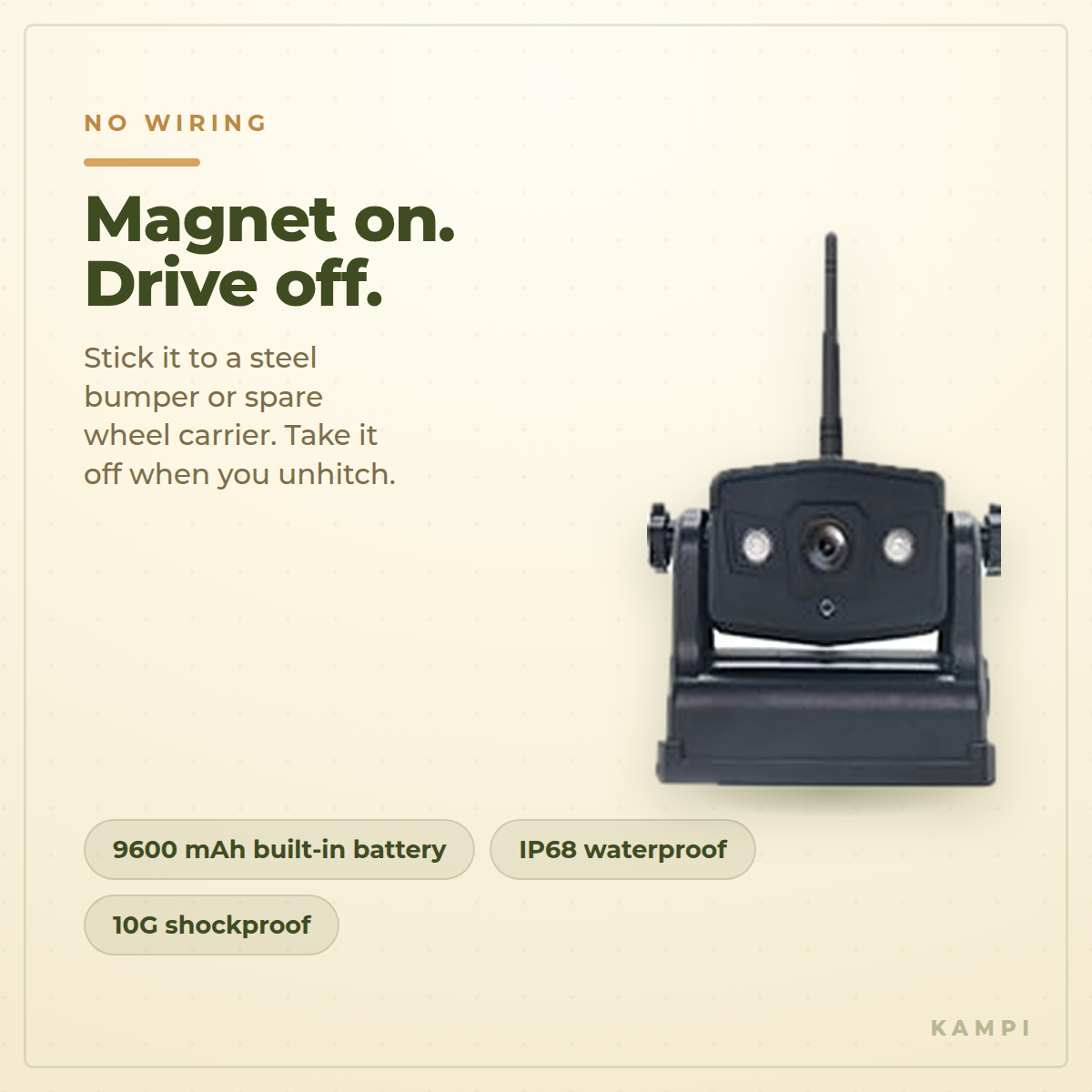
The wireless magnetic towing camera has a 9,600 mAh battery and a magnetic base. You stick it on, drive, and take it off when you arrive. Nothing is wired into the caravan, so it moves from one caravan to the next.
The catch: a magnet needs steel. Most caravan bodies are aluminium or fibreglass, and a magnet will not hold on either. Look for steel at the back of the rig, usually the bumper bar or the end of the chassis, and test it with a fridge magnet before you buy. And charge it the night before you leave.
The wireless towing camera with bracket mount bolts on with a steel U-bracket and runs off the caravan's own 12 to 24 V supply. It has no battery, so there is nothing to charge and nothing to forget. An auto electrician can fit it in an hour or so. Once it is on, it stays on.
Both systems take a second camera, and the screen then splits in two. A common setup is one camera on the back of the caravan and one looking down the side.
Three questions settle it.
"Owners who rent out should bolt it on," says JP. "A camera that lives on the caravan is one less thing to hand over, charge or chase after the trip."
You do not have to buy one to tow with one. Some owners on Kampi list a wireless towing camera as an extra, the same way they list a gazebo or a porta potty. You will see it on the listing page under the extras, and you add it when you send your booking request.
If you are new to towing, take it. The first reverse onto a busy stand at the campsite is the moment most first-timers would pay anything for an extra pair of eyes. Your passenger will also thank you, since the alternative is them standing behind the caravan shouting "a bit more" for ten minutes.
Ask these at the handover, then switch it on and check the picture before you drive away, not on the N1.
A towing camera is one of the few extras a renter will thank you for on the first night. It also helps with the small damage that keeps turning up after rentals: a corner panel or a tail light that met a pole on the way onto a stand. If you rent out more than one caravan, put one magnetic camera on the extras for all of them. Owners with a single caravan should fit the bracket camera and mention it in the listing description.
Add it under Equipment in your owner dashboard, choose which caravans it goes with, and set your price. Our owner maintenance checklist covers the rest of the handover.
A camera will not make a tight reverse easy. Twenty minutes in an empty parking lot on a Sunday morning does more for that. Our guides on towing for the first time and what your licence lets you tow cover the rest. The full set lives in Kampi Guides, in English and Afrikaans.
Then find a caravan near you, or browse the Kampi Store for the camera to put on your own.