Following distance, the 100 km/h bakkie rule and what to do when the caravan sways. The short version of the Kampi Guides towing page, for first-time renters.
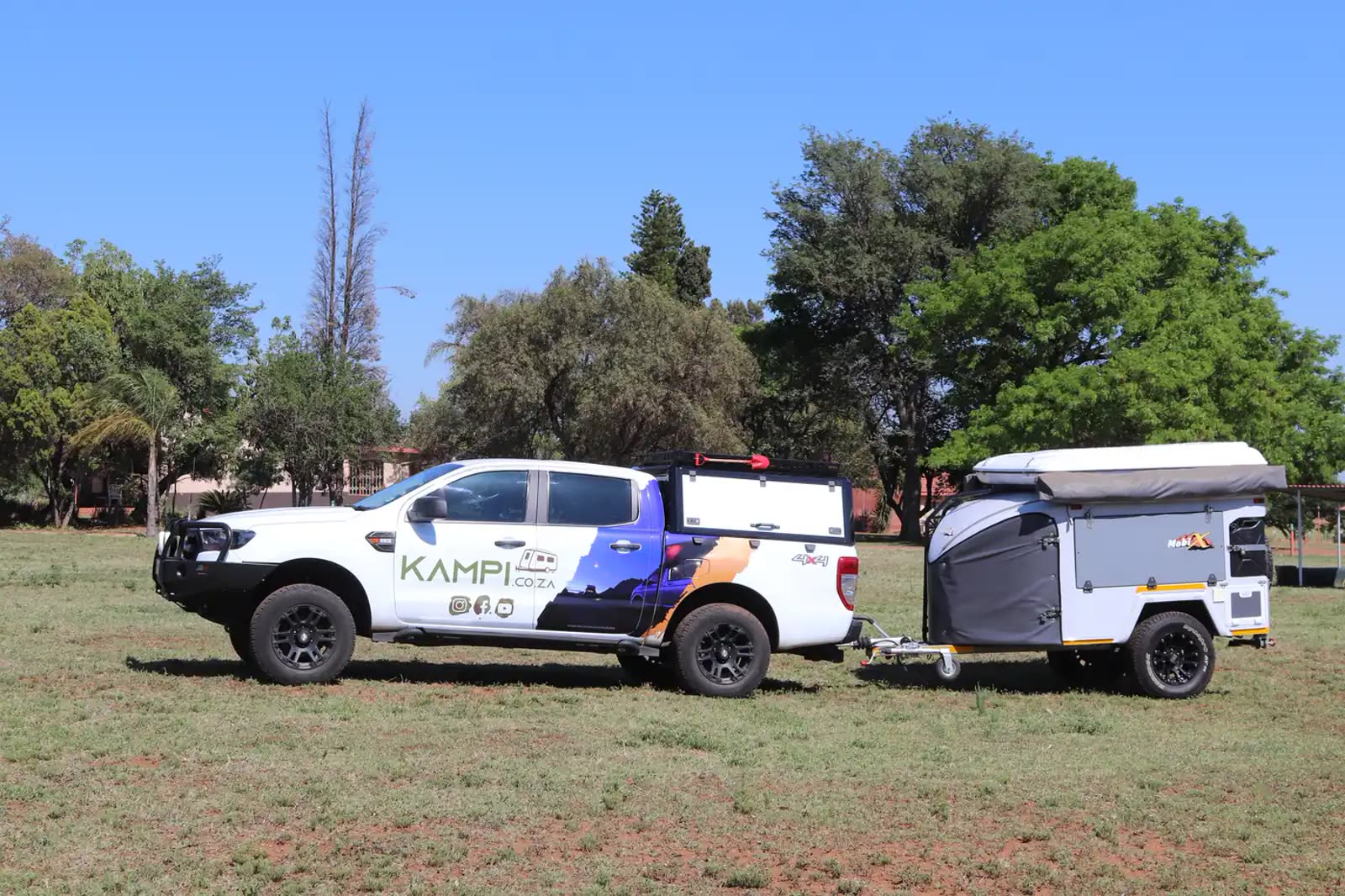
You pull out of the owner's driveway and the bakkie feels heavy. In the mirrors there is a wall where the road used to be. At the first robot you brake where you always brake and stop a metre late. At the first corner the caravan's wheel bumps up the kerb, and your passenger says nothing, which is worse than saying something.
That is a normal first ten minutes. You are driving something longer, heavier and much slower to stop, and the caravan's wheels do not follow the car's. Give it 20 km of quiet road and your brain catches up.
Most people collecting a caravan through Kampi are in exactly that position. By 16 September 2026, 6,388 trips had been completed on the platform. Behind them stand 4,797 renters, and 3,775 of those have rented exactly once. So the person hitching up on a Friday afternoon is usually doing it for the first time, and the questions they send us are the same ones every week. How fast may I go? What do I do if it sways? How much gap do I leave?
We have written the answers down once, properly, at library.kampi.co.za. This post is the short version of the towing guide, with the three things that matter most. The full page, with the regulations quoted and 20 sources at the foot, is at Towing a caravan for the first time. There is an Afrikaans edition too: Eerste keer sleep.
Leave far more room than feels necessary. Drive slower than the limit. If the caravan starts to sway, ease off and hold the wheel straight.
The rest of this post is the detail behind those three sentences. If you want the whole thing, the library page has it.
A loaded caravan adds stopping distance on top of your reaction time, and that extra distance grows on a wet road or a downhill. Everything happens later than you are used to. The only fix is space.
The AA of South Africa's rule is three seconds, plus one for every factor that makes things harder. Towing counts. So do wet roads, night, and following a truck. Their figure for towing is at least five to six seconds. Count when the car ahead passes a roadside post; you should reach that post after the count, never before.
It feels like a huge gap, and cars will slot into it. Let them, and drop back. JP Voogt, Kampi's founder, puts it this way: "That gap is for the bakkie in front of you that brakes for a goat outside Vanrhynsdorp. At 100 km/h with 1,400 kg behind you, there is no buying that metre back."
In a real emergency, brake hard and keep the wheel straight. Do not swerve. With a caravan behind you, a swerve invites a jackknife or a rollover.
The answer depends on what you drive, and it surprises most bakkie owners.
South Africa has no general towing speed limit. Regulation 292 of the National Road Traffic Regulations gives everyone 60 km/h in town, 100 km/h on a rural road and 120 km/h on a freeway. A sedan, hatch or SUV towing a caravan keeps those ordinary limits.
A bakkie is a goods vehicle in the eyes of the law, and Regulation 293 caps a goods vehicle combination at 100 km/h once the bakkie's GVM plus the caravan's GVM passes 3,500 kg. A double cab has a GVM of roughly 2,900 to 3,300 kg, so with any caravan behind it the sum is over 3,500 kg every time. That means 100 km/h on every road, and a 100 km/h sign on the back of the caravan. The trigger is the sum of the two GVMs on the licence discs, not the GCM.
Whatever the road allows, Kampi's advice for every combination is 100 km/h or less. Sway gets worse with speed and stopping distance grows with it. Arrive Alive calls speeding the number one cause of accidents when towing.
The regulation text, and how the numbers on your licence discs decide what you may legally tow at all, are in the library's first guide: What can I tow? If you are not sure whether your licence covers the caravan you are looking at, start with our EB licence guide, or browse the campers you can tow on a Code B licence.
Sway, or snaking, is the caravan swinging left and right behind you, each swing a little wider than the last. You feel it first as a wobble through the seat. Left alone at speed, it can take the car with it.
The moment it starts:
Do not brake hard. Do not steer against the swing. Do not speed up.
Then work out why it happened. On a first trip it is nearly always loading plus speed. Open the caravan and look for anything heavy that has crept to the back: the braai, the jerry cans, the toolbox. Move it forward and low, over the axle. Check the nose weight if you can, check the tyre pressures, and set off again slower.
"Every sway story I have heard from a renter ends the same way," says JP. "The heavy stuff was packed last, so it went in at the back door. Pack the caravan like you are loading a wheelbarrow: weight over the wheel, or it fights you."
A stabiliser fixes none of this. The Caravan Club puts it plainly: a stabiliser damps out small oscillations from wind and passing trucks. It will not rescue a badly loaded caravan or a poor vehicle match, and no South African law requires one.
A truck pushes a wave of air ahead of it and drags a hole along behind it. Expect a tug on the caravan as you clear its wind shadow, whether it is oncoming or you are overtaking. Both hands on the wheel, ease off, hold it straight.
On a pass, get your speed up before the climb and shift down early. On the way down, pick a lower gear and let the engine hold you back, braking in short, firm dabs rather than riding the brakes. If the temperature gauge climbs, slow down, drop a gear, and pull over to let it cool. Pull into a crawler lane or a layby and let the queue behind you go.
Slow down before the tar ends. Most people drop tyre pressures a bit for gravel and corrugations and pump up again before the tar. There is no single South African figure to give you: go by the caravan's plate, the tow vehicle's placard, and ask the owner what they run. That question belongs in the handover conversation, not on the side of the R355.
Stop about every two hours or 200 km. Gas off before you fill up, which is the SANS 10087-2 rule for any caravan in motion or being refuelled. Then walk around the outfit:
Grinding, grease on a rim or a burning smell means you stop right there. Do not push on to the next town. Roadside assistance is part of every Kampi booking; the numbers are on our roadside assistance page. For anything caravan-specific, the owner is your first call.
Towing is one afternoon of a caravan holiday. The library covers the whole trip, in the order it happens, and each guide takes about ten minutes to read:
There is also a one-page printable towing checklist. Print it, fold it, keep it in the door pocket, and tick it off in order every time you hitch up. It pairs with our older caravan departure checklist, which covers what goes in the caravan before you leave home.
Over the next few weeks we will walk through each guide here on the blog, one a week, in trip order. If you are booking for the Heritage Day long weekend or the December holidays, read the towing and collecting guides before the handover, not the night before you leave.
The library has one guide for owners, and it is the longest of the lot: the caravan maintenance checklist for owners who rent out. A rental caravan works harder than the family one, and the renter who collects it on Friday cannot tell a tired bearing from a good one. The checklist covers the walk-around before every handover, the hour you give it every few rentals, the once-a-year workshop visit, and the papers that stay on board.
"A renter's sway problem is often the owner's nose-weight problem," says JP. "If your caravan has never been on a scale with the water tank half full, you do not know what you are handing over. That is the one number I would want before I let anyone tow my unit."
If you are new to renting out, pair it with our host guide to preparing your camper for rentals and the post on what happens before a stranger gets your keys.
Read the guide, print the checklist, then find a caravan from a real owner near you. Handover, insurance and the deposit are handled on Kampi, and most owners will happily talk you through the hitch on the driveway. Ask them what pressures they run on gravel while you are there.
Kampi Guides are general information, not legal advice. Check the regulations and your own vehicle's plate before you tow.