Before every rental, every month and once a year: tyres, bearings, gas, battery and the paperwork. The maintenance rhythm for caravans rented out on Kampi.
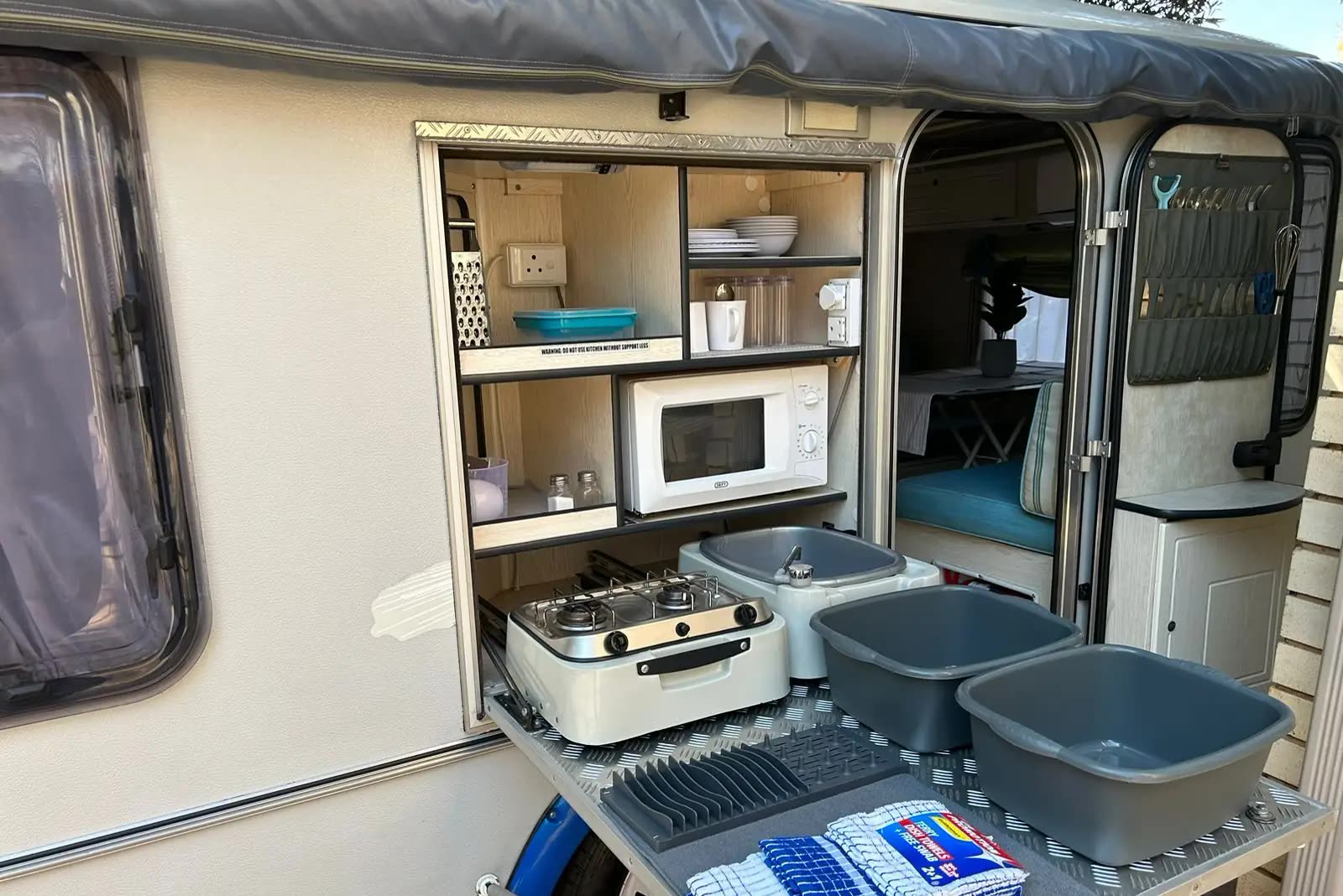
A private caravan stands in the yard for most of the year. Once or twice a year it goes to the coast, comes home, gets washed and goes back under the carport. A rental caravan on Kampi can go out with a new driver every few days through December, each with their own idea of what "gravel road" means.
Things wear. And the renter who collects your caravan on Friday cannot tell a tired bearing from a good one. By the time they notice, it is your caravan on the side of the N1.
For the past six posts this series has been written for renters: what they may tow, how to drive it, and how to collect, reverse, set up, live in and return a caravan. This last one is for the people who own them. It is built on the longest guide in the Kampi Guides library: the caravan maintenance checklist for owners who rent out. In Afrikaans: Eienaar instandhouding kontrolelys.
Break the job into three rhythms:
That is the Kampi Care rhythm. If you missed the October check this year, December is still six weeks away. Book the workshop now, before every other owner in Gauteng does the same.
Write every check down. A filled-in service booklet feeds your Listing Health Score, and "the last renter did not complain" is not a maintenance record.
"The renter is not your mechanic," says JP Voogt, Kampi's founder. "They will tell you about the dent they made. They will never tell you about the bearing that was already going, because they have no idea what a going bearing feels like."
Do this the day before handover, hitched to your own vehicle on level ground, so a flat battery or a dead indicator has time to be fixed. It is the same walk-around the renter is told to do on the collecting your caravan page, so anything you skip is what they will find.
Caravan tyres die of age and sun, not kilometres. Inflate cold to the caravan's own plate, spare included. Tread clearly visible across the full width and nowhere level with the wear bars. Read the date code on every tyre: "2219" means week 22 of 2019, and Continental's South African advice is to replace caravan tyres at six years, eight at the very latest, however much tread is left. Wheel nuts with a hand torque wrench, cross pattern: AL-KO gives 88 Nm for M12 bolts on steel wheels, 110 Nm for M12 on alloy and 135 Nm for M14.
Plug pins clean and bright, with no green corrosion. Every light tested with a helper at the back. Most intermittent light faults are corrosion at the pins or at an earth point, so look there first.
Lift test on the ball. Overrun damper moves freely, no oil weeping. Breakaway cable intact and long enough to corner. Handbrake lever goes fully up and comes fully off. Corner steadies wind freely.
Cylinder upright in its vented locker, bracket tight. Regulator and hose in date, washer not perished. Soapy water on every joint, every appliance lit once and switched off.
Earth leakage unit trips on its test button. No tingle from the door frame or chassis. Battery above 12.6 V after standing at rest for six hours, which is Kampi Care's handover line. Most "the solar is broken" messages from renters turn out to be a flat battery.
Pump run with no pulsing at the tap. Fridge run for 20 minutes. Windows, hatches and lockers latch. Canvas dry, zips run, no mildew smell. Dated photos of every locker and the chair count, ready for the handover form.
Unhitch, chock and give it an hour.
Bearings are the quiet killer. AL-KO's schedule for a taper-roller axle is a play check after 1,500 km or six months and a grease check after 10,000 km or twelve months. Kampi's fleet rhythm is the same, with 2,500 km for real off-road use. A set of bearings and seals costs under R500. A hub that lets go near Kuruman does not.
Damp is the slow one. Hardware store silicone fails in 18 to 24 months of South African sun. Use a UV-stable polyurethane sealant and plan a full re-seal of roof and windows every three to four years.
"Bearings and water. Those are the two that quietly finish a rental caravan," says JP. "Both are cheap to catch in the driveway and very expensive to find at the side of the road."
Book a workshop for the parts you should not do yourself: bearings repacked or renewed, brake shoes and drums, the coupling damper and linkage, the chassis checked for cracks at the coupler weld and spring hangers, the shock absorbers, and an absorption fridge service. The gas system gets a leak test by a SAQCC Gas registered installer, with the hose (five years, SANS 1156-2) and regulator (five years, SANS 1237) ages recorded. Replace an AGM battery at five years.
Our service centres page lists the workshops Kampi uses. One of them, Noord Karavane, is run by the brother of a Kampi founder, so you know where our bias sits.
The tare and GVM on the disc are what the renter and a traffic officer will read. Our what can I tow post tells renters to compare them with their own licence disc before they book, so put the plated GVM on your listing too. If you have added a battery box, a second cylinder and a roof rack since registration, the tare on the disc may no longer be true.
Every Kampi booking includes insurance for the trip, and both of you get the digital handover form two days before check-in. That booking cover is for the trip, not for the caravan standing in your yard, so keep your own policy alongside it.
Handbrake fully up and every wheel chocked. Tyres covered from the sun. Battery stored full, on a charger or solar, never flat: heat roughly doubles an AGM's self-discharge for every 10 degrees, so a caravan baking in the yard loses charge about four times faster than one in a cool garage. Water system drained, fridge off with the door propped open, cylinder valve closed, canvas stowed bone dry.
December is when your caravan earns the most and works the hardest. Our high season pricing guide covers the money side. The maintenance side is simple: a caravan that breaks down on the 18th of December costs you the rest of the season's bookings, not just a repair.
New to renting out? Start with the host guide to preparing your camper for rentals. Not listed yet? List your caravan on Kampi.
The best thing an owner can do for their own caravan is send the renter a link before collection day. Someone who has read the guides arrives knowing the steadies are not jacks, the breakaway cable does not go round the jockey wheel, and the canvas does not go home wet. The full renter set, in trip order:
Plus the one-page printable towing checklist. Print a copy and leave it in the caravan's cubby. It is the cheapest maintenance item you will ever buy.
Kampi Guides are general information, not legal or mechanical advice. Your caravan's handbook and your workshop have the final word.