Code B or EB? It comes down to the caravan's GVM, not a combined 3,500 kg. The licence rule, brakes, tow ratings and what to ask the owner before you book.
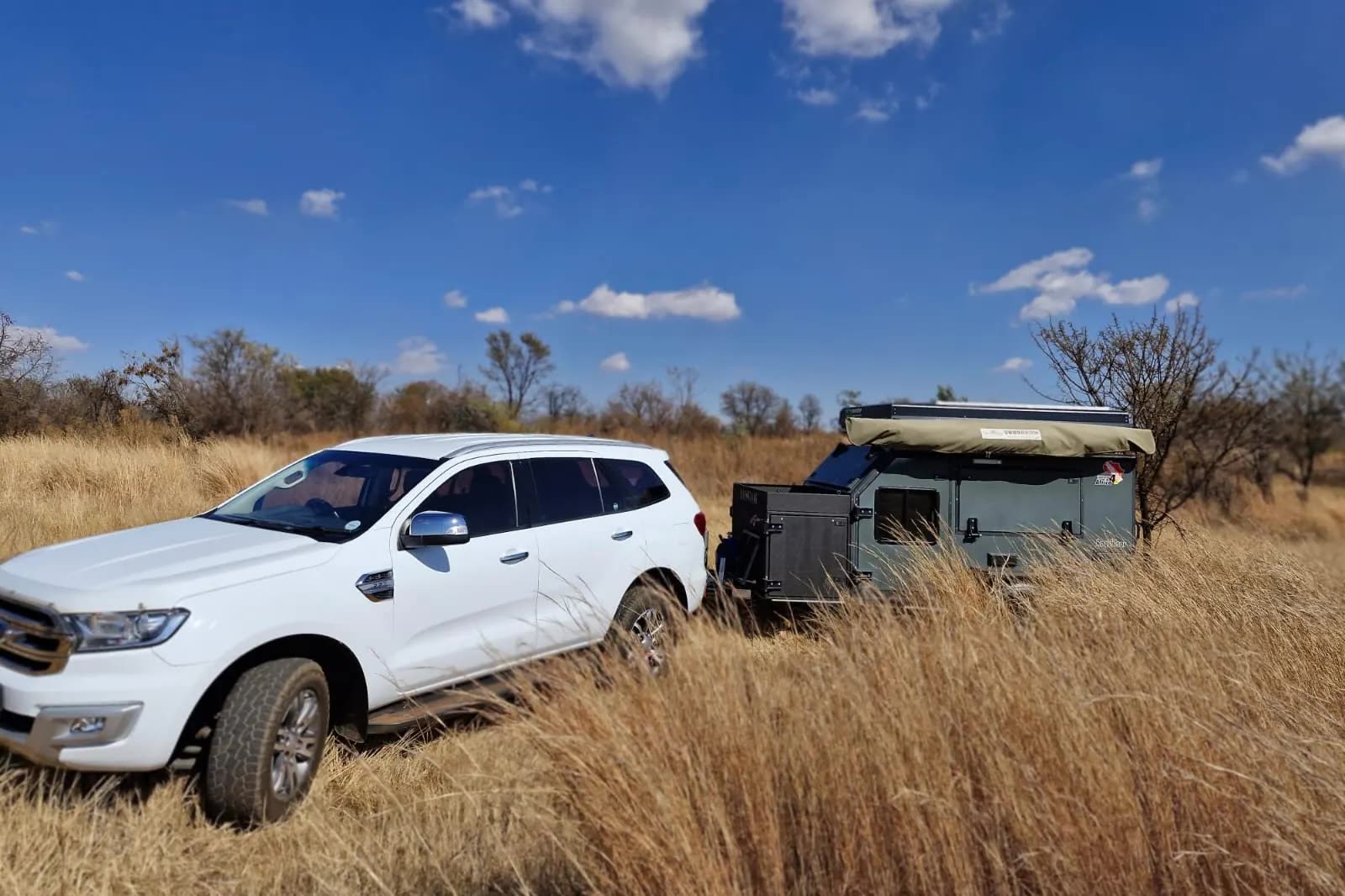
Somebody at the braai always knows. "You can't tow that on your licence, bru, the combined weight is over 3,500." Somebody else says it depends on the engine. A third person has a cousin who got fined at a roadblock outside Bela-Bela. By the time the chops are done you have three answers, all delivered with total confidence, and you still do not know if you can collect the caravan you have been looking at.
Here is the honest answer: it comes down to one number, and it is not the one most people argue about.
This is post two in our weekly series built on Kampi Guides, the free towing and caravan library we wrote for first-time renters. Last week was towing a caravan for the first time. This week is the question that comes before it, and the one we get asked most: what can I tow? The full guide quotes the regulations word for word and lists 24 sources. There is an Afrikaans edition too: Wat kan ek sleep?
Find the caravan's GVM (gross vehicle mass, the most it may weigh loaded). It is on the caravan's licence disc and its plate, and on Kampi it should be on the listing or one message away from the owner.
That is the whole licence test. One number.
On Kampi right now, 255 of the 415 live listings need Code EB. The other 160 can be towed on a plain Code B, and they are all on one page: campers you can tow without an EB licence. Most of those are off-road trailers, rooftop-tent trailers and small pop-tops. A Sprite Swing sits around 1,240 kg GVM and a Jurgens Penta around 1,800 kg, so most proper caravans are EB territory.
You will hear it from dealers, read it on forums and find it on some big websites. It sticks because the number is real. It is just pinned to the wrong vehicle.
Regulation 99 of the National Road Traffic Regulations asks one question about your tow vehicle: is it light? That means a tare of 3,500 kg or less for a car, SUV or motorhome, or a GVM of 3,500 kg or less for a bakkie. Just about every double cab and every SUV on the road passes. The Code EB rule then says nothing at all about how heavy the caravan may be, or the two together.
"I have lost count of the people who told us they could not rent a caravan because of the 3,500 kg rule," says JP Voogt, Kampi's founder. "Turn your licence card over. If it says EB, or you had an old Code 08 from before 2000, you are probably already sorted. Half of South Africa is arguing about a number that is on the wrong vehicle."
One footnote. A tow vehicle whose own GVM is over 3,500 kg, which some Land Cruiser 79 variants are, needs Code EC1 whatever it tows.
If you do need the endorsement, our EB licence guide covers the process. Budget R2,500 to R7,000 and four to eight weeks for the learner's test, a handful of lessons and the K53 yard and road test.
Your licence says what you may drive. It says nothing about whether your car can pull that caravan. For that you need four numbers, and none of them is on your licence card.
Tare and GVM for both vehicles are on the two licence discs. A bakkie must carry a data plate with tare, GVM, axle loads and GCM. Then there are the two numbers people skip: the towbar's own stamped maximum (an aftermarket bar can be rated lower than the vehicle it is bolted to), and the nose weight, which on any South African caravan must land between 25 kg and 100 kg under the compulsory VC 8026 specification.
Line all of them up. The smallest one is your limit.
"Whatever the smallest number on the paperwork is, that is your real tow rating," says JP. "The brochure number is the biggest one, which is exactly why it is on the brochure."
With normal caravan brakes, no. This is the rule that catches out small SUVs.
Regulation 151 does not ban heavy caravans. It sets the brakes a trailer needs, depending on how the trailer's GVM compares to your tow vehicle's tare. Once the caravan's GVM is more than your vehicle's tare, the caravan needs a service brake the driver can operate from the cab while moving. An overrun brake, which works off the caravan's own momentum, does not count. Almost every caravan in South Africa has overrun brakes.
So in practice: put the two licence discs next to each other. The caravan's GVM may not be more than your tow vehicle's tare. Engine size does not come into it, whatever the oom at the braai says.
The guide has a table of common tow vehicles pulled from the official South African spec sheets. Two things jump out.
First, the derivative matters more than the badge. An Isuzu D-Max 1.9 is rated to tow 2,100 kg braked. The 3.0 is rated to 3,500 kg. Same bakkie from the outside. A 2WD Hilux double cab is rated at 2,750 kg, the 4x4 at 3,500 kg. A Suzuki Jimny tops out at 1,300 kg, and a base VW Tiguan at 1,800 kg.
Second, a rating is not a budget to spend to the last kilogram. Isuzu's own footnote says a D-Max 3.0 towing the full 3,500 kg may weigh only 2,500 kg all-up to stay inside its 6,000 kg GCM. That leaves about 425 kg for people, fuel, gear and the load on the tow ball. A family of four and a weekend's worth of camping kit uses that up before you have packed the braai.
Say you drive a double cab with a GVM of 3,200 kg and a tare around 2,000 kg, and you want a caravan with a plated GVM of 1,800 kg for a week in the Drakensberg.
If you are close to any limit on paper, most truck stops have a weighbridge that charges R30 to R80. Weigh the loaded combination once. It ends the argument.
Do this with the listing open and your licence disc in your hand, not from memory. Then ask the owner:
A good owner answers all five without blinking. The guide's full ten-point pre-booking checklist is at the bottom of the what can I tow page, and there is a one-page printable towing checklist for the door pocket.
If you rent out a caravan on Kampi, the single most useful thing you can add to your listing is the plated GVM. It answers the licence question before anyone has to ask it, and renters who have checked their numbers in advance are the ones who turn up with the right bakkie and the right towbar.
The library has a full maintenance checklist for owners who rent out, including the papers that should stay on board. Pair it with our host guide to preparing your camper for rentals.
Numbers work? Then the next step is the owner's driveway. Next week we cover collecting your caravan: the handover, hitching up with a checklist in your hand, and why you stop after the first 20 km. If you cannot wait, the rest of the library is already up, in trip order:
Ready to look? Browse caravans near you, or go straight to the Code B list if your card only says B. Planning ahead for the December holidays? Check the numbers now, while there is still choice.
Kampi Guides are general information, not legal advice. Check the regulations and your own vehicle's plate before you tow.