Why the kettle trips the park box, how long the battery really lasts, gas and water rules, and when the awning comes down. A caravan weekend, sorted.
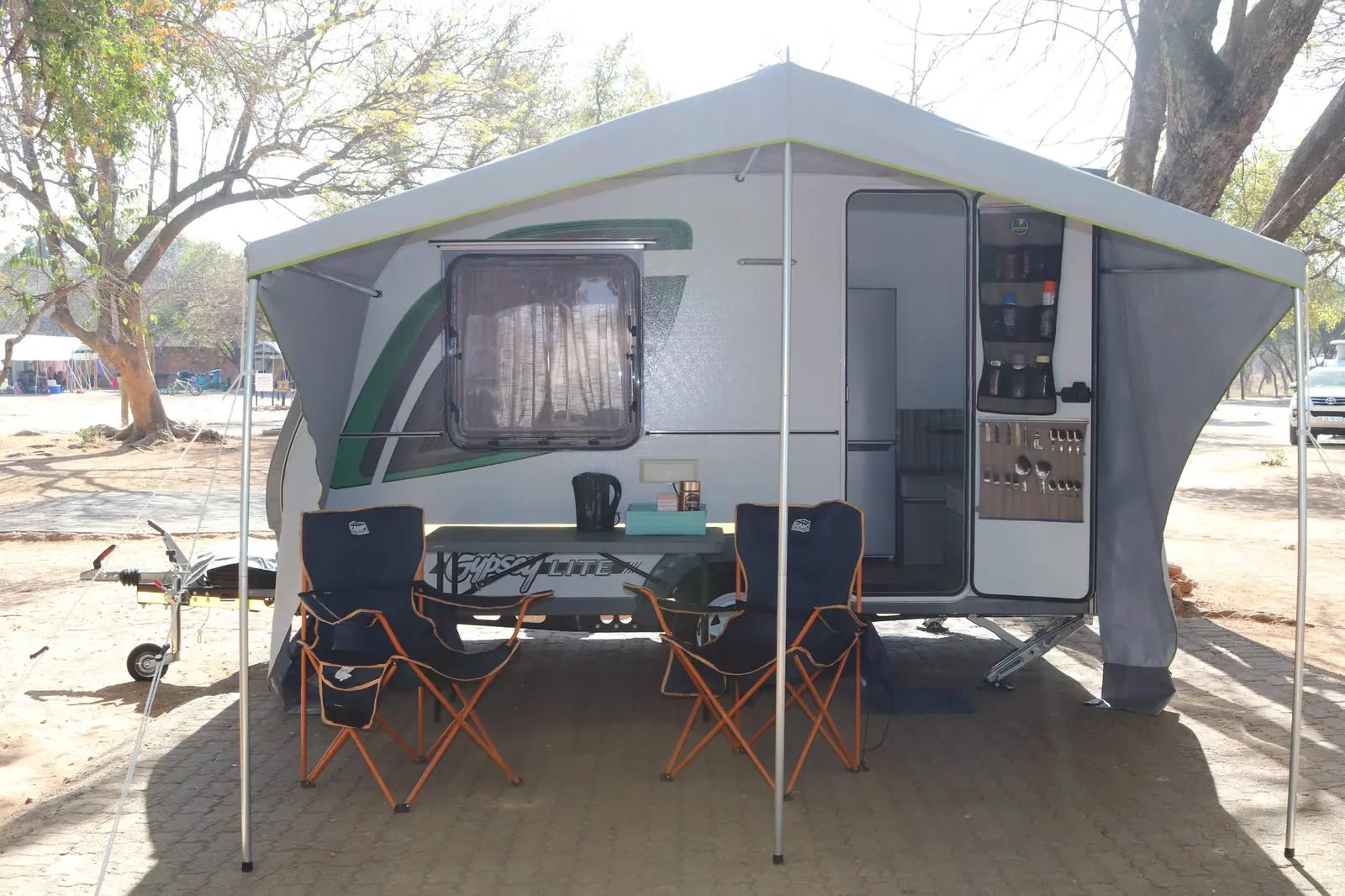
Saturday, seven in the morning. Someone puts the kettle on. Three stands down, someone else does the same, and so does the family next to them. There is a click from the power box, and the whole row goes dark. Nobody knows whose fault it was, which is the only thing that saves the peace.
Most of a caravan weekend looks after itself. What catches first-timers is the power point, the battery, the gas and the weather.
This is post six in our weekly series built on Kampi Guides, the free library for first-time caravan renters. So far: what you may tow, the drive, collecting, reversing and setting up. This week is the days in between: living in a caravan for a weekend. In Afrikaans: Lewe in die karavaan.
The lights, the water pump and a 12 V fridge run off the battery. The kettle and the heater need the park's 220 V, and they are the two things that trip the box. Gas cooks and heats, but it never runs in a closed caravan. Tank water is for washing unless the owner says otherwise. And the awning comes down before the wind arrives, not while it is blowing.
The usual park set-up is one distribution box feeding up to four sites through a single earth leakage unit. Your kettle shares that unit with the neighbours' kettles, and when everyone brews coffee at once, the whole thing trips. A coiled lead or a wiring fault in the caravan will do it too.
Boil water on the gas stove. If the box trips with only your caravan on it, unplug and phone the owner, because that one is not the neighbours.
"A 2 kW kettle on a shared park box at seven in the morning is a lottery ticket," says JP Voogt, Kampi's founder. "Use the gas for coffee and keep the park power for the fridge and the battery charger. Everyone on the row gets their breakfast."
An AGM battery gives you about half its rated capacity before you start shortening its life, so a 105 Ah AGM has roughly 52 Ah to spend. Lithium gives 80 to 90 percent. And remember it is not your battery.
The fridge eats most of that. A 60 litre 12 V fridge set to +4 degrees uses about 14 to 18 Ah a day at 21 degrees outside, 20 to 25 Ah at 32 degrees, and up to 35 Ah at 43 degrees. Turn it down to -6 and it uses over three times what it does at +4.
Do the sum for a hot weekend in the Kalahari with no park power: 52 Ah usable, 35 Ah a day for the fridge alone. By Sunday you have a problem. Set the fridge for the job, not for the coldest number on the dial. Cold beer does not need a freezer.
A three-way fridge (gas, 220 V and 12 V) is different. Its 12 V setting only holds temperature while you drive. At camp, run it on 220 V or gas, and keep the caravan level or it will not cool.
If there is a solar panel, a 100 W panel gives roughly 32 to 38 Ah a day in Gauteng sun and 22 to 28 Ah in overcast KwaZulu-Natal. Lying flat, it loses 30 to 40 percent, so prop a portable panel up and point it at the sun. Our solar, battery and fridge power guide goes deeper.
To read the battery honestly, let it rest for six hours with nothing charging or drawing. At rest, about 12.7 V is full and 12.1 V is half. A reading taken with the fridge running tells you nothing.
Cook with a window or roof vent open, and never fall asleep with the stove or a gas heater burning. Leave the wall vents and the gas locker vents alone, and do not pack anything against them. Get into the habit of closing the cylinder valve last thing at night.
Every time you reconnect a cylinder, check the regulator's washer is there, then soapy water on the joints and watch for bubbles. Never a match. The cylinder stays upright, strapped down and away from the braai.
And if someone does grab the wrong end of a hot pan: cool running water for 20 minutes. No ice, no butter, no toothpaste. The rest of the kit is in our camping first aid kit guide.
The WHO puts drinking alone at about 5 litres per person per day, and about 20 litres once you cook, wash hands and do dishes. Kampi's own checklist says 5 litres a head minimum for drinking, 8 to 10 in summer, plus a 20 litre reserve you do not touch.
Tank water is not drinking water just because it came out of a tap. No South African standard covers caravan tank hygiene. Use it for washing and cooking, and carry bottled water or boil for drinking. Grey water from the sink and shower goes to the dump point, not the grass under the caravan.
The cassette toilet: one dose of chemical plus 2 to 3 litres of water lasts roughly four to five days. Blue additive is for cassettes emptied into a sewer, green for septic dump points. Never mix the two.
Summer storms over the interior build in the late afternoon and stay local. A clear morning promises nothing. When one arrives, the awning goes first. Heavy-duty pegs and storm straps at a wide angle hold it in a breeze, and the commonest failure is simply too few pegs. Once it is properly blowing, the awning comes down. Do it before the wind arrives, never mid-gust.
"Nobody has ever lost an awning to a storm they packed up for," says JP. "They lose them to the storm they thought would miss."
Canvas does nothing against lightning. Get into the hard-topped bakkie or a building, and stay away from lone tall trees and ridges.
Heat costs you battery and water. At 43 degrees the fridge draws about double what it does at 21. Pick a stand with afternoon shade if you have any say in it.
Heading for the Kruger, the lowveld or Kosi Bay between September and May? Those are malaria risk areas on the Department of Health's map. See a pharmacist or travel clinic before you go.
Lock food away from monkeys and baboons. Leave snakes alone. If someone is bitten, move them away from the snake, keep them calm, take off rings and tight clothing, and get to a hospital with an emergency room. No cutting, sucking, ice or tourniquet. From any cellphone, 112 gets you emergency services.
For the food side of the weekend, our BosKampKos camping food post and the camping hacks list are good reading on the Friday night.
Kampi Care asks owners to hand over with the battery above 12.6 V at rest, about 90 percent charged, and the gas cylinders in date. A flat battery on the first night is an owner conversation, not the renter's mistake. Leave a note in the caravan saying which fridge setting to use at camp; it saves you a phone call on Saturday morning. The full list is in Kampi Care.
Next week, the last of the renter guides: packing up and returning the caravan, and how to get your deposit back without an argument. The full library:
Then find a caravan near you. Planning a December holiday? Ask the owner about the battery size and whether there is solar before you book. It changes what a weekend off the grid looks like.
Kampi Guides are general information, not legal advice. Check the regulations and your own vehicle's plate before you tow.