Braai burns, deep cuts, sprains: what SA campers actually treat, what the pharmacy kit misses, and the first aid kit built for Kampi by working first responders.
Here is an uncomfortable number to pack with the marshmallows. South Africa's official target for a rural ambulance is 40 minutes. Research in the rural Eastern Cape measured the real average at closer to four hours. At a campsite outside Kruger, deep in the Berg, or halfway up a Karoo pass, the first stretch of any emergency belongs to you. Not to a paramedic. To you, standing there with whatever you thought to pack.
That is not a reason to stay home. It is a reason to pack like an adult.
Most camping first aid kits are bought in the same trolley as the firelighters: a soft pouch with 60 plasters, one roll of tape, a pair of plastic tweezers and a booklet nobody reads. It ticks the box on the departure checklist and helps with almost nothing that actually happens at a campsite.
Because here is what actually happens at a campsite. Someone grabs a grid that has been on the coals. A child runs barefoot past the fire. A knife slips while someone is cutting boerewors rolls against their palm (you know who you are). An ankle rolls in an aardvark hole on the way to the ablutions in the dark. Elke kampeerder ken hierdie stories. None of them are solved by 60 plasters.
"The braai burn is the classic South African camping injury," says JP Voogt, founder of Kampi. "Everyone packs for snakes and packs nothing for the fire they are going to stand around for six hours a night."
After 6,000+ completed trips on Kampi, the injuries campers actually deal with fall into four groups. Build your kit around them, in this order.
Braai grids, gas stoves, kettles, exhaust pipes. Burn care is the biggest gap in shop-bought kits, and it is the one where the right first response genuinely changes the outcome. The current international guidance (ANZCOR guideline 9.1.3) is 20 minutes of cool running water, as soon as possible, and it still helps up to three hours after the burn. Then a proper hydrogel burn dressing and burn gel, which cool the wound and keep it clean without sticking. Not ice. Not butter. Not toothpaste, oom.
A plaster handles a blister. It does not handle a wound that bleeds through a cloth. For that you need sterile trauma dressings (first aid dressings, the kind with the bandage attached), gauze, conforming bandages and gloves. Gloves matter more than people think: nobody reaches confidently into a bleeding wound with bare hands, and hesitation costs time.
Crepe bandages for compression, triangular bandages for slings and splint ties. Gravel, tree roots, wet ablution floors and dark paths supply the injuries; your kit supplies the support until you can get to a doctor. The rule JP gives Kampi renters: "Pack the kit for the worst night of the trip, not the best day."
Rescue blankets for shock and cold, a CPR mouthpiece, scissors that can cut clothing, tweezers for thorns and ticks, alcohol swabs to clean your tools. This is the layer nobody uses on 95 trips out of 100, and the layer that matters most on the other five.
We got tired of recommending kits we did not believe in, so we did it properly. We sat down with The First Responders, a South African team of working emergency responders who build medic bags for a living, and asked them one question: when you get called to a campsite, what do you actually use? The Campsite First Aid Kit on the Kampi Store is their answer.
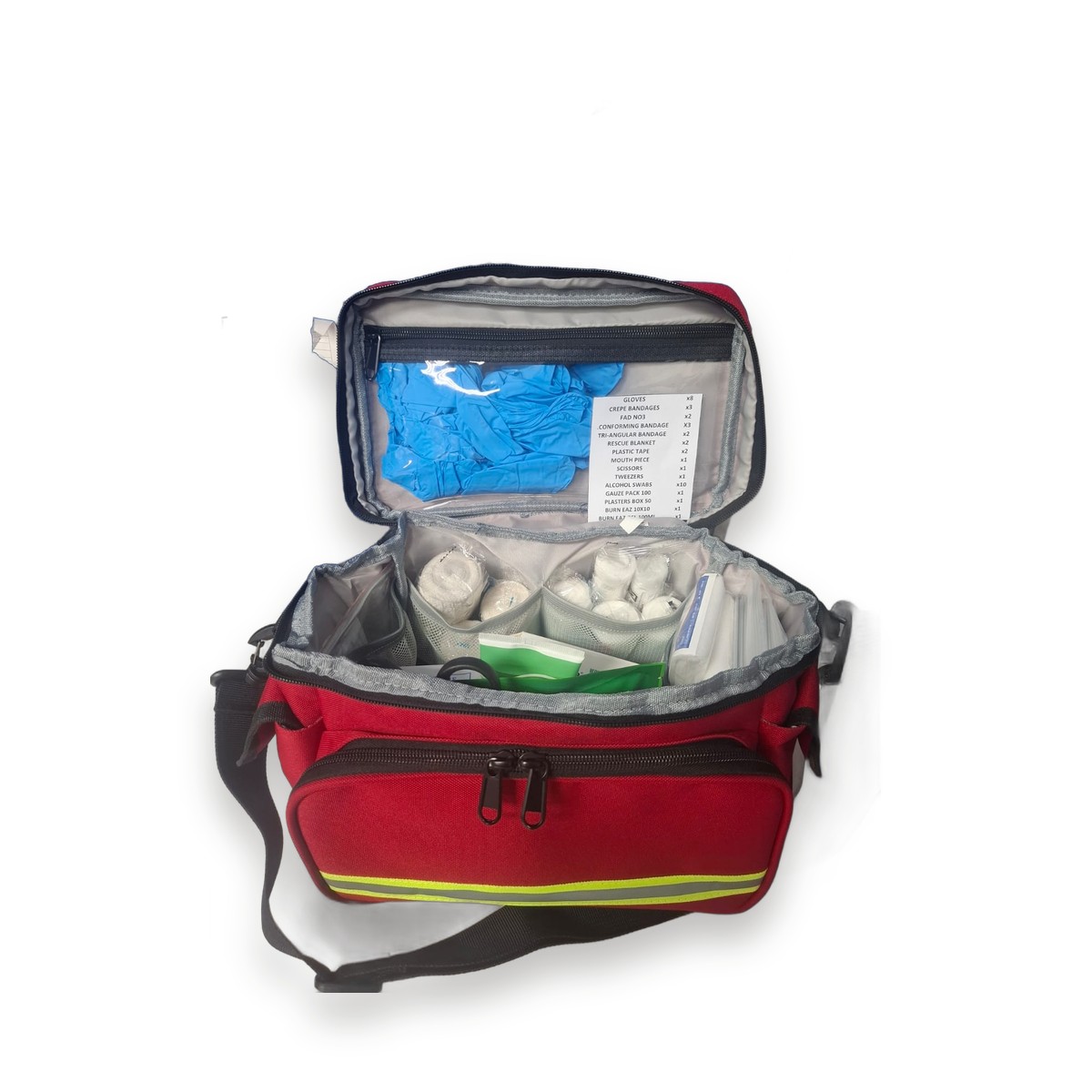
Inside: Burn Eaz burn dressing and 100ml burn gel, two sterile trauma dressings, 100 gauze swabs, three crepe and three conforming bandages, two triangular bandages, two rescue blankets, eight nitrile gloves, a CPR mouthpiece, scissors, tweezers, alcohol swabs, tape, and yes, a box of 50 plasters too. Everything sits in see-through compartments with a printed contents list in the lid, so you can find things fast and restock after every trip. The bag has a reflective strip, a shoulder strap, and a front organiser left deliberately open for your own medicine.
"A kit you have to dig through is a box, not a kit," says JP. "In an emergency you get about ten seconds of clear thinking. The bag must do the organising for you."
A smaller vehicle version, built for the cubbyhole of the tow vehicle, is on its way to the store as well.
First aid kits are sold without medicine inside, and that is correct: everyone's needs are different, and half the value is talking to a pharmacist about yours. So the kit leaves space, and you take this list on your next Clicks or Dis-Chem run:
Ask the pharmacist about ages, doses and what mixes with your chronic medication. That advice is free at the counter and it is worth more than anything a blog can tell you, this one included.
A first aid kit helps you respond while help is on the way. It is not a substitute for professional care, and it is not a licence to take bigger risks. It is simply the difference between standing there with a wet cloth and standing there with a plan.
The Campsite First Aid Kit is on the Kampi Store now. Put it in the camper before the December rush, tick it off next to the trip checklist and the power plan, and then go book the camper. Mooi loop.