Documents, fees, and border post tips for cross-border camping with a rented trailer in Botswana, Namibia, and Mozambique.
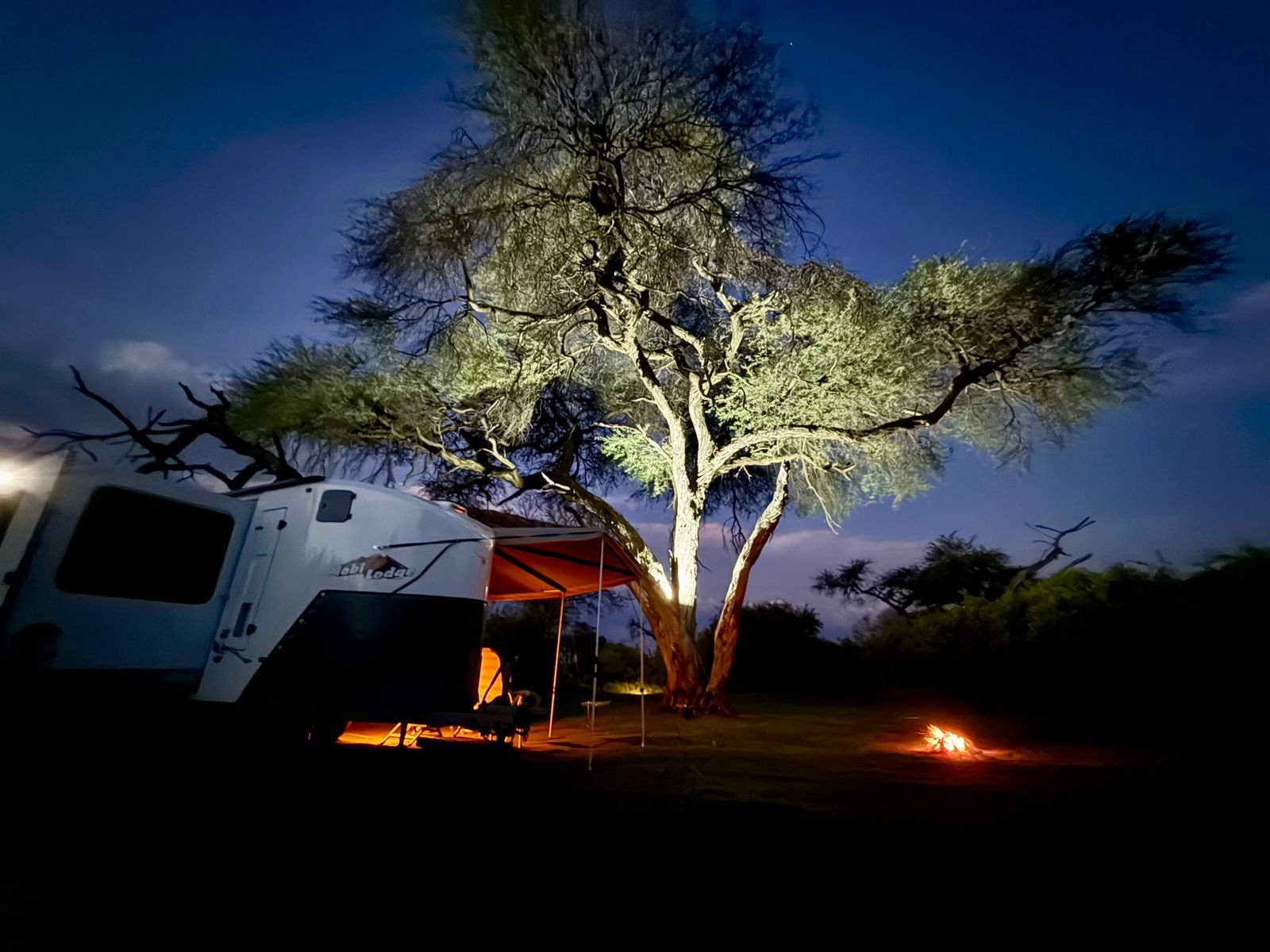
The Botswana border official flips through the papers a second time, then a third. Your tow vehicle documents are fine. Your passport is fine. But the trailer. The trailer belongs to someone else, and all you have is a handwritten note from the owner with no dates, no ID number, and no witness signature. He sends you back across the bridge.
This exact scenario plays out every peak season. Not because the rules are complicated, but because no one asked the right questions at booking. Cross-border camping with a rented camper is legal and entirely doable. The border post is just where you find out whether you prepared or not.
This guide covers what you actually need for Botswana, Namibia, and Mozambique: the documents, the fees, the border post hours, and which destinations work for a towed trailer.
Yes, but only if the owner explicitly permits it and provides the correct paperwork. Not all owners on Kampi allow their campers to cross international borders. It is a reasonable restriction: their asset, their registration papers, their insurance. When you contact an owner about a cross-border trip, do it at the booking inquiry stage. Not the week before departure.
"Ask about the authorization letter when you book, not when you are packing," says JP Voogt, who co-founded Kampi in 2021. "Getting that letter properly witnessed by a Commissioner of Oaths takes time. It is not something you can sort out on a Sunday evening before a Monday border crossing."
The single most important piece of paper for crossing into any of these three countries with a vehicle you do not own is the owner authorization letter. This is not a police clearance certificate (which proves no criminal record, and is not required for Botswana, Namibia, or Mozambique for private tourist travel). It is a written statement from the registered owner giving you permission to take their property into a foreign country.
The letter must be witnessed by a Commissioner of Oaths. Any bank branch, notary, or SAPS station can do this. It costs nothing at a bank and takes ten minutes. Without the Commissioner of Oaths stamp and signature, the letter carries no legal weight at most border posts.
What the letter must contain:
A letter that says "permission to travel in Southern Africa" with no dates will likely be rejected, particularly in Mozambique. Be specific. If you are going to Botswana and Namibia on the same trip, list both. If the Kampi trailer is owned by a company, the letter must come on company letterhead, signed by an authorised company representative, and witnessed by a Commissioner of Oaths.
Carry the original. Carry certified copies. Keep them in separate places in the vehicle.
Beyond the owner authorization letter (Commissioner of Oaths witnessed), you need:
At the border, BURS (Botswana Unified Revenue Service) issues a Temporary Import Permit (TIP) for both the vehicle and the trailer. These are issued separately. Budget approximately P50 for single entry plus P20 for the road fund levy plus P50 for third-party insurance per vehicle, and a separate P20 for the trailer. A round trip with trailer runs roughly P250. Cash only. Do not count on a card reader at the border post. Pula is preferred; Rand is accepted in many tourist areas but at an unofficial rate.
Tlokweng/Kopfontein (North West Province) is the most practical crossing for caravans and trailers. It operates 06:00 to 00:00 and the staff are familiar with tourist traffic. Pioneer Gate/Skilpadshek is a quieter alternative on the same hours. Martin's Drift/Groblersburg in Limpopo reopened in 2025 after flood damage and suits routes into the northeast and Tuli Block, but closes at 22:00.
Fuel in Botswana is slightly cheaper than in South Africa. The critical planning point: there is no fuel between Kasane and Maun, roughly 550 km on gravel. Gweta station, which sits roughly halfway, has a reputation for running dry. Carry jerry cans. ATMs are available in Maun and Kasane; rural areas are cash-only.
Chobe National Park at Ihaha campsite is manageable with a 2WD bakkie and decent ground clearance, though Savuti further in is deep sand and 4x4 mandatory. Khumaga in Makgadikgadi is reachable with a 4x4 if you take the correct approach route. Moremi Game Reserve and the Central Kalahari Game Reserve (CKGR) are sandy and remote. Technically, trailers are permitted, but the terrain will test even a short dedicated off-road trailer and is inadvisable for anything longer. Chobe is the sensible Botswana choice for a first cross-border trip with a towed unit.
Campsite bookings for Botswana national parks go through four private operators: Big Foot Tours (CKGR, Khutse), SKL Group (Chobe, Moremi, Makgadikgadi/Nxai), Xomae Group (Moremi, Makgadikgadi/Nxai), and Kwalate Safaris (Chobe, Moremi). There is no central booking portal. Popular sites in peak season (June to October) book out 6 to 12 months ahead. Park entrance fees are paid separately in cash at the gate.
Same basic set: owner authorization letter (Commissioner of Oaths witnessed), certified copies of the registration papers for the tow vehicle and the trailer separately, ZA stickers on both, licence and passport.
One difference from Botswana worth knowing: South African tourists do not need a Temporary Import Permit for vehicles or trailers entering Namibia. This is confirmed by both Tracks4Africa and the AA. No Carnet de Passage required either.
At the border, the Road Fund Administration (RFA) collects a Cross Border Charge (CBC) covering road use and third-party insurance in one payment. Budget approximately N$350 for the tow vehicle and N$140 for the trailer. The CBC is paid per crossing, so if you exit and re-enter, you pay again. The Namibian Dollar is pegged 1:1 to the Rand. SA Rand is legal tender in Namibia and accepted everywhere. You do not need to exchange currency before entering, though carrying cash is still wise as card readers at border posts are unreliable.
One important check before you go: your standard South African vehicle insurance almost certainly does not extend to Namibia. Contact your insurer before departure and ask about an SADC extension.
Both Vioolsdrif/Noordoewer (Northern Cape, Orange River crossing) and Nakop/Ariamsvlei (Northern Cape, Kalahari route) operate 24 hours. Vioolsdrif is the most commonly used for trailers heading south toward Fish River Canyon. Nakop suits the Augrabies-to-Kalahari route.
Fuel in Namibia is cheaper than in South Africa and widely available along all B-road routes. C and D roads require planning. Card payments work at most larger Namibian towns. The B1 from the border through Windhoek to Etosha is tarred and in excellent condition.
Etosha is Namibia's most trailer-friendly national park. The internal roads between the fenced camps (Okaukuejo, Halali, Namutoni) are graded gravel and manageable with a 2WD and trailer. All three main camps have designated campsites with power points. Book through Namibia Wildlife Resorts (NWR), but note that the online system can be unreliable, so email [email protected] directly. Okaukuejo is in high demand and books months ahead during June to September.
Sossusvlei and the Sesriem campsite are also trailer-manageable. The road from Sesriem gate to the 2WD parking area is tarred. The final 5 km to Sossusvlei requires the park shuttle or walking.
Damaraland is where trailers become impractical. The D roads involve sand river crossings and rocky tracks that are genuinely difficult even without a trailer. The Skeleton Coast is in the same category. Stick to Etosha and Sossusvlei if you are towing.
Mozambique has the most detailed requirements of the three. Along with the standard set (owner authorization letter Commissioner of Oaths witnessed, certified copies of the registration papers for vehicle and trailer separately, ZA sticker), you also need:
At the Alfandega (customs) desk, obtain a Temporary Import Permit (TIP) for the vehicle and a separate TIP for the trailer. Ask for the trailer TIP explicitly. Officials do not automatically include it when processing the vehicle. An unstamped TIP is invalid. Check both before you leave the border area. The TIP is valid for 30 days; if your trip exceeds 30 days, you must get an extension before it expires.
Third-party liability insurance (CTPL) is compulsory for all non-Mozambican vehicles and trailers. It is available at the border from Hollard Mozambique. Budget approximately R150-160 for the tow vehicle and R80-140 for the trailer.
TIP fees must be paid in Meticais. Exchange Rand to Meticais at the BP garage complex in Komatipoort, roughly 1.4 km before the border. The exchange rate there is noticeably better than at the border itself. Card readers at Lebombo/Ressano Garcia are unreliable. Carry cash in both currencies.
Avoid the unofficial "runners" who approach at Ressano Garcia offering to assist with paperwork. There are no official fees for document assistance. Do the forms yourself.
Komatipoort/Lebombo/Ressano Garcia operates 06:00 to 00:00 (extended to 24 hours during peak holiday periods). This is the practical crossing for caravans and trailers heading to Inhambane, Tofo, and Vilanculos. Best crossing window on a weekday: 09:30 to 13:30. The EN4 toll road from the Mozambique gate to Maputo is in excellent condition.
The Kosi Bay/Ponta d'Ouro crossing in KwaZulu-Natal operates 08:00 to 17:00. Arrive before 16:00, as no grace period is given. This crossing is for light vehicles and 4x4s only, not large caravans. The roads inside Ponta do Ouro require 4x4 and deflated tyres (0.8 to 1.4 bar depending on vehicle weight).
Fuel in Mozambique is more expensive than in South Africa. Fill up before crossing. The EN1 from Maputo to Vilanculos and Inhambane is generally well-maintained two-lane tar, but has pothole sections, particularly after the rainy season (December to March). Speed cameras are active. Avoid driving after dark. Livestock on the road at night is a genuine hazard.
Tofo Beach and Inhambane are reachable with a high-clearance 2WD and a trailer via the EN1, roughly 480 km from Maputo (6 to 7 hours). Vilanculos is further at approximately 700 km and 9 to 10 hours from Maputo, but the road is manageable and the camping and boat access to the Bazaruto Archipelago make the distance worthwhile.
Ponta do Ouro is the coastal destination closest to the SA border but the most technically demanding. 4x4 and deflated tyres are required within town and for beach access. Keep trailer length short if you go this route.
The Maputo Special Reserve requires 4x4 inside the reserve. The EN4 to the gate is tarred.
Before you commit to a cross-border trip with a rented camper, confirm these with the owner:
The morning of your crossing, before you reach the border:
Cross during business hours, not right at closing. Border staff dealing with documentation queries at 21:45 are less helpful than at 10:30.
Over 5,800 trips have been completed through Kampi. The ones that cross the Limpopo, the Orange River, or the Lebombo Mountains without incident are always the ones where the paperwork conversation happened at booking, not at the gate. Browse cross-border-enabled listings and raise the authorization letter in your first message to the owner. Everything else (fuel stops, campsite bookings, border post timing) you can plan once you know the camper is cleared to go.
For a full pre-trip preparation list, read the 4x4 camper trip checklist. If you are comparing rental options for a long Botswana expedition, the Botswana camping guide with a Mobi Lodge covers what a serious off-road trailer handles. And if power supply across five nights without hookup concerns you, the camper power guide covers solar, battery, and fridge setup in plain numbers.