Rent a camper for your child's rugby tour, father and son camp or veldskool: park at the grounds, skip the 5am hotel scramble, plus the benefits for kids.
It is 5:45 in the morning. Your son's first match kicks off at 7:30, the warm-up is at 6:45, and the hotel breakfast room only unlocks at seven. You are standing in a strange passage with a travel kettle that trips the plug, trying to make instant coffee while your kid hunts for a clean pair of socks. The field is a twenty minute drive away, and so is every other rugby parent, all leaving at once. You booked this room four months ago and it was still the last decent one in town.
Any parent who has followed a school sport tour knows this morning. The same goes for the father who signed up for the school's father and son weekend, and the mom who volunteered to help at a younger grade's camp. The trip itself is wonderful. The logistics around it are where the stress lives: accommodation that is fully booked, far from the action, expensive for what it is, and run on someone else's timetable.
There is a calmer way to do these trips, and it parks right next to the action. A rented camper or caravan turns the venue itself into your base. You sleep where your child plays, you cook on your own clock, and when the long day is done you are already home. This guide walks through the three trips South African parents take most often, the camp tours, the father and son weekends, and veldskool season, and the real, researched reasons why getting your kids outdoors is worth the effort.
Craven Week, the big inter-provincial rugby festivals, netball tours, the Easter rugby weekends: South Africa runs one of the most serious schools sport calendars in the world, and it has done since the first Craven Week in 1964. That is a lot of away matches, and a lot of parents driving across provinces to stand on the sideline.
The accommodation maths rarely works in your favour. During a tournament every guesthouse within range of the grounds is booked out months ahead. What is left is either far away, overpriced, or both. Then there is the meal timing. Junior sport runs on early starts, and a hotel breakfast that opens at seven is useless when your child needs to eat at half past five.
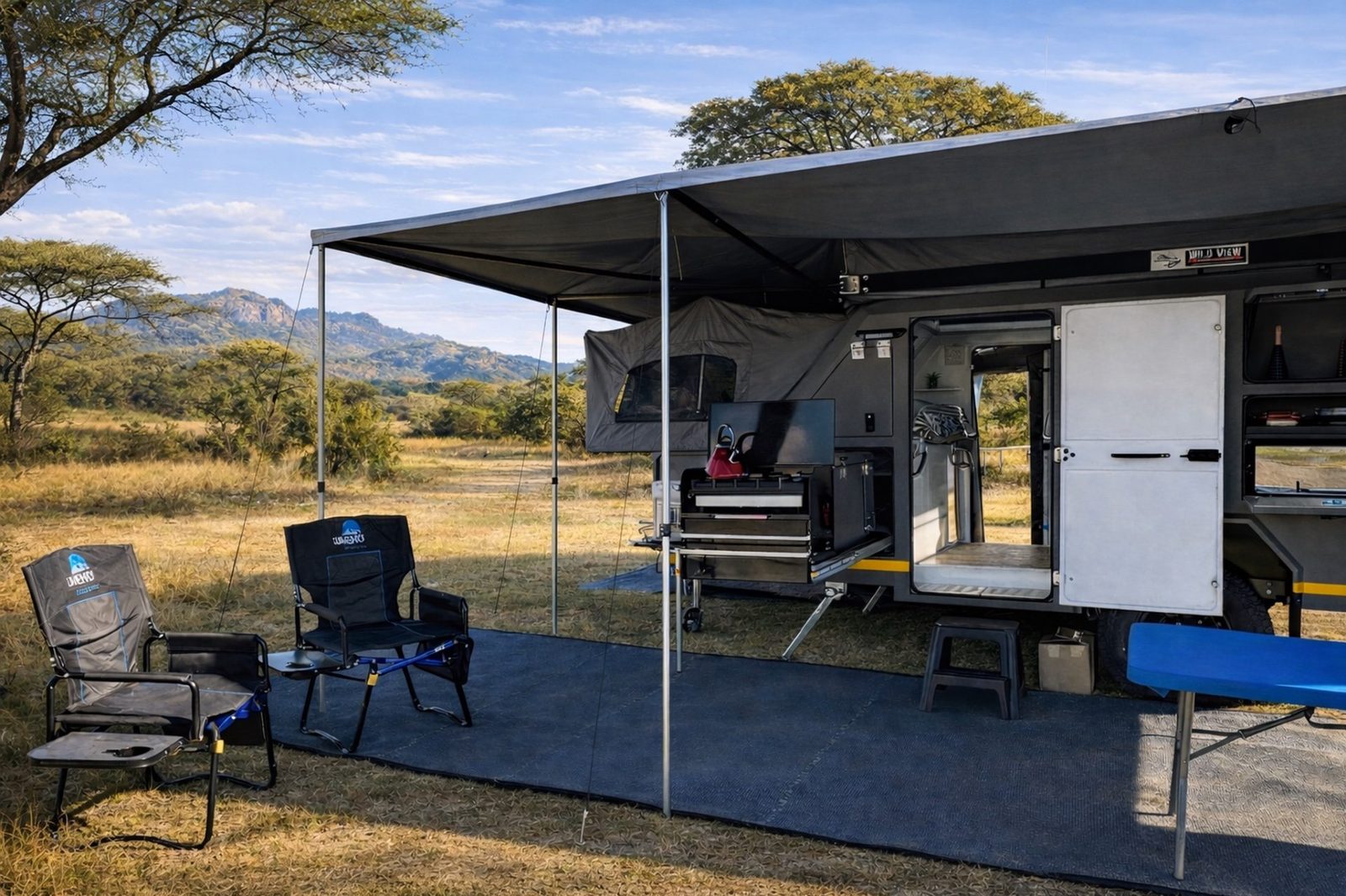
A camper fixes the two things that actually matter on tour: where you sleep and when you eat. Park at or near the sports grounds and you cut the tournament-morning traffic out entirely. You have your own kettle, your own fridge, rusks and a proper breakfast ready at whatever hour the fixture demands. You are ninety seconds from your child when they need you, and far enough that they still feel like they are on tour with the team and not with mom and dad.
"Book the camper to solve the 5am problem, not the five star fantasy. On tour you want to be near the field with your own kettle, not chasing a breakfast that opens after the warm-up." JP Voogt, Kampi founder
If your child's tour lands during Craven Week, our Craven Week camper guide covers the host towns and dates. When you are ready to see what is available for your dates, you can search campers near the venue directly.
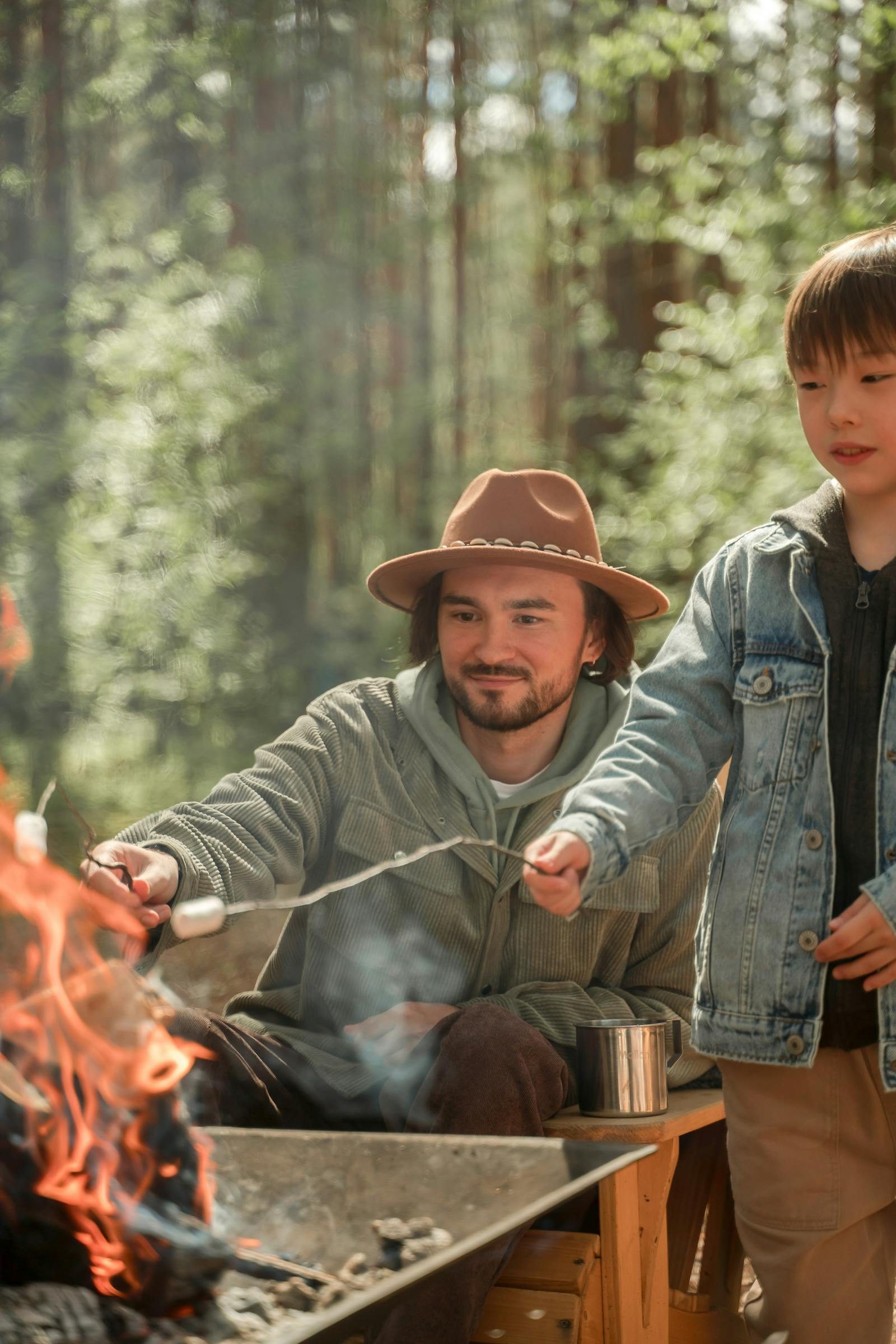
Some of the best trips have no scoreboard at all. School father and son weekends, church and youth camps, and the kind of manne-naweek that ends around a fire are a long South African tradition. Organisations like The Character Company run dedicated dad and lad camps built entirely around that campfire bond, and the wider Christian Camping Southern Africa network runs camps across the country.
The trouble with these weekends is that they often land somewhere with no lodge, no rooms, and nowhere to put a tired father at the end of the day. A tent is fine when you are twenty. After forty, setting one up in the dark after a four hour drive is how relationships get tested. A camper gives you a real bed, a locked door, a fridge for the meat and a roof when the weather turns, without losing the open-fire, sleep-under-the-stars feeling that makes the trip worth taking.
It also works beautifully as a roaming base for a Drakensberg or bushveld weekend with the whole family. Our Drakensberg escape page is a good place to start, and if you have never towed anything before, the complete guide to renting a camper in South Africa walks you through it from scratch. Afrikaanssprekende ouers kan ook ons volledige gids om 'n karavaan te huur lees.
Veldskool, the bush or field school, is one of the oldest traditions in South African schooling, especially in Afrikaans schools. It is usually a five day camp, Monday to Friday, somewhere out in the Northern Cape or the bushveld, where children learn leadership, teamwork, bush survival and a healthy respect for nature. Many of us went once in primary school and again in high school, and we still remember it.
A quick and honest note for parents: whether mom or dad can tag along depends entirely on the school and the camp. Some schools run veldskool as a pupils and teachers only affair, others welcome parent helpers and chaperones, and the rules differ year to year. Always check with the school first before you plan around attending. The point of veldskool is partly to let kids stretch their independence, so do not assume a parent place is on offer.
Where a camper earns its keep around veldskool is the bookends and the in-between. Drop-off and pick-up days at remote camps are long drives, and a camper lets you stay over nearby instead of doing the round trip twice. If you are an approved parent helper, it gives you your own quiet, comfortable space at the edge of a camp built for thirty noisy children. And if your school does not run veldskool, you can give your own kids a version of it: a few self-catered nights in a real wild place, which is exactly what the research below says they need.
This is not just a nice idea. The benefits of getting children into nature are some of the best documented findings in child wellbeing research, and they line up neatly with everything a camp or a tour weekend already does.
Start with the head. A 2024 meta-review in The British Journal of Psychiatry, pulling together sixteen systematic reviews, found that time in natural environments has a real, beneficial effect on the mental health and wellbeing of children and adolescents. More immediately, a study in Frontiers in Psychology showed that just a thirty minute walk in nature measurably restored children's attention compared with the same walk through a city. Nature even lowers the body's main stress hormone: researchers found that time outdoors dropped cortisol by over twenty percent an hour, with most of the benefit landing in the first twenty to thirty minutes.
Then there is sleep, which is gold on a sport tour. Scientists at the University of Colorado Boulder found that a single weekend of camping, away from screens and artificial light, shifted people's internal body clock earlier by well over an hour. Natural light at dawn and dusk resets the melatonin cycle, which is to say your kid actually sleeps, and wakes up ready to play.
For teenagers, the kind on a rugby tour or a leadership camp, the gains run deeper. A 2024 meta-analysis in the Journal of Adventure Education and Outdoor Learning found that outdoor adventure education significantly improves adolescents' resilience, self-esteem and sense of social belonging. And for the school camp angle, a review of 147 studies across twenty countries, published in Frontiers in Public Health, found that outdoor learning delivers measurable academic, social and wellbeing benefits.
The flip side is screens. Research in Pediatric Research documents how screen time directly displaces the unstructured play that builds self-regulation in young children. A camp or a tour weekend does that displacing for you. A Touchstone Research survey of camping families (a brand survey rather than a peer reviewed study, so take it as colour) found that nine in ten mothers rated camping as one of the best ways to strengthen family bonding, and that screens largely vanish around a campfire. Even closer to home, a South African study in BMC Public Health linked the quality of children's outdoor environment to how physically active they are.
"Screens go quiet around a fire on their own. You do not have to confiscate anything. The bush does the parenting for a weekend." JP Voogt, Kampi founder

Here is a trip skill worth more than any badge. Hand your child a paper map and put them in charge of the route. Our partners at Tracks4Africa make the best paper touring maps in Southern Africa, the kind that do not need signal, battery or a data bundle to work. On the drive to a camp or a tour, let the kids trace the route, call the turns, and work out how far the next town is.
It sounds small, but a child who can read a map can orient themselves in the real world, do mental distance and time maths, and keep a cool head when the blue dot on a phone disappears. That is the whole point of veldskool wrapped into a R200 map.
"A kid who can read a paper map can find himself when the screen dies. That is a life skill, not a holiday gimmick." JP Voogt, Kampi founder
Plenty of the best camps and bush venues sit well outside cellphone coverage, which is exactly where a parent's mind starts to wander. For genuinely remote trips, a satellite communicator closes that gap. A device like the Garmin inReach, available in South Africa through Tracks4Africa, runs on the Iridium satellite network rather than cell towers, so it sends text messages and an emergency SOS from places with no signal at all.
You do not need one for a rugby weekend in Paarl. But if your trip takes you deep into the Kalahari, the Richtersveld or up into the Drakensberg passes, the inReach Mini 2 is the difference between being unreachable and being a two way message away. Think of it the same way you think of a first aid kit: not for the good days, for the one bad one.
Honest answer: it depends on the camper, the dates and how long you are away, so we are not going to pretend a single number fits every trip. What we can tell you is how Kampi pricing works so you can do the maths yourself. Campers are priced per day on Kampi, and that day rate includes the pickup and return day. On top of the daily rate there is insurance at R89 per day and a Kampi service fee (shown at checkout). That is the whole picture, no surprises at handover.
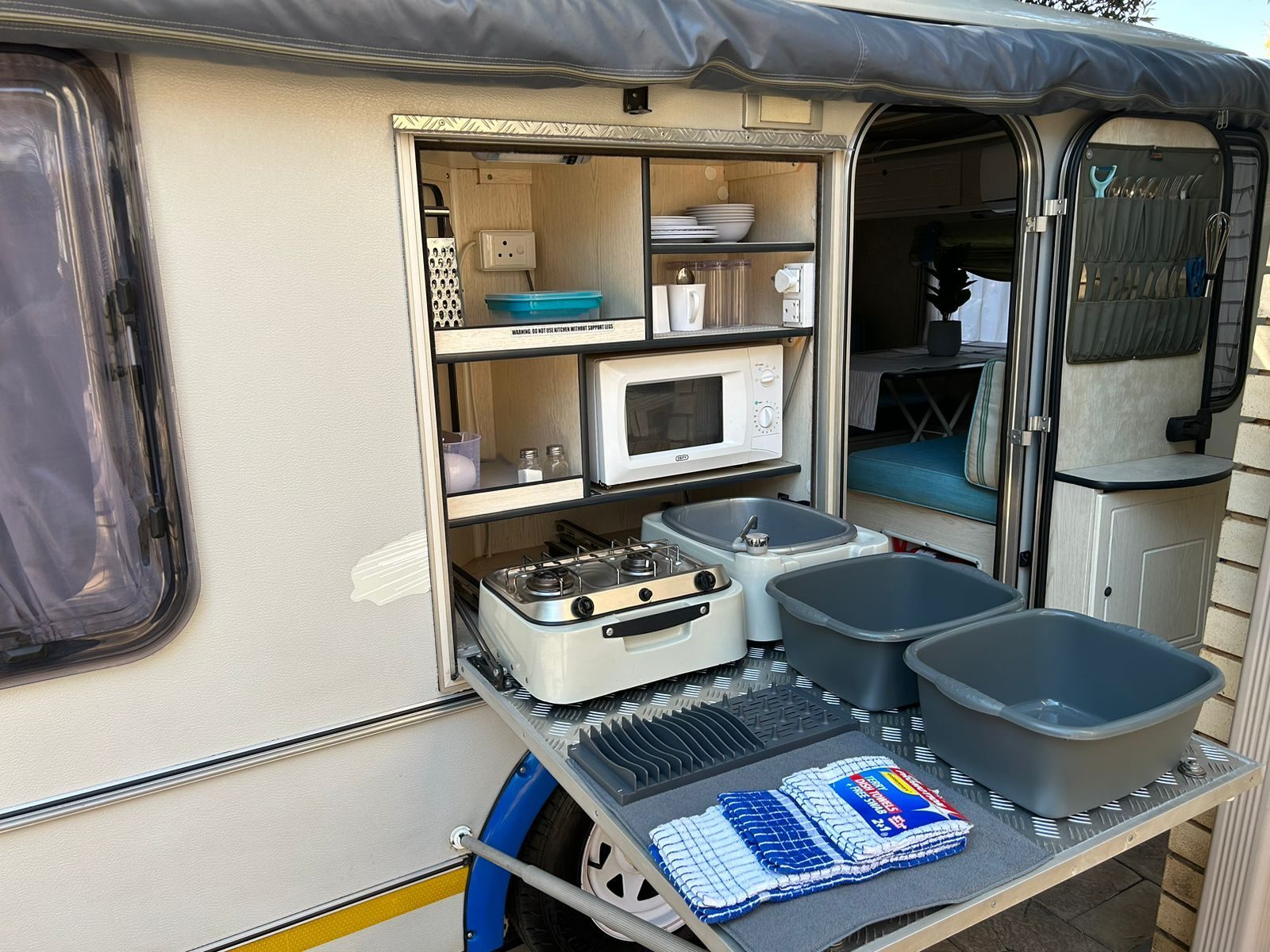
The reason a camper often wins for these trips is not a magic low price, it is what one booking replaces. A camper is your room, your transport for the gear, and your kitchen in one unit, parked where you need it. For a five day veldskool drop-off or a week-long tour where the alternative is multiple hotel nights plus restaurant meals plus fuel running back and forth, that bundle adds up differently.
Kampi is a peer to peer marketplace, so you are renting a real camper from its owner, not a faceless fleet. Across nearly 5,900 completed trips and almost 400 listed campers, the practical advice is simple: book early for tournament and veldskool season, because the good units near popular venues go first. The fastest way to get a real number is to search your dates and venue and see actual campers with actual prices.
You do not need to know caravans to pick the right one. Answer three questions and the choice narrows itself.
One more practical point: licensing. A small, light camper can usually be towed on a standard Code B licence, while a heavier caravan needs a Code EB. We have a full breakdown in the EB licence guide, and a page of campers you can tow without an EB if that is your situation.
Once you have found a likely camper, a few quick questions to the owner save a lot of grief later:
Good owners answer all of this happily, and the conversation tells you a lot about how the trip will go. Before you pull off, run through the caravan departure checklist so nothing important gets left in the driveway.
The match scores fade. The weekend your son navigated the last forty kilometres with a paper map on his lap, or the morning your daughter's whole team had breakfast around your awning before a final, those stick. A rented camper does not just solve the 5am problem and the no-rooms-left problem. It puts you closer to your kids, in a wilder place, doing the exact thing the research says is good for them.
When the next tour, camp or veldskool season lands on the calendar, find a camper near the venue and turn the logistics nightmare into the best part of the trip.