Choosing between an off-road trailer, off-road caravan, or road caravan for your SA camping trip. Match the camper to the terrain before you book.
You have found two listings on Kampi. Both sleep four. Both have a fridge and a gas stove. Both are described as suitable for off-road use. One is an off-road trailer at R720 a night. The other is an off-road caravan at R1,240. You are not sure what the difference is, or which one suits the trip you are planning.
This is the question most renters get to only after booking, when they are already on the road. This guide answers it before you commit.
On Kampi, listings fall into three main categories when it comes to towable campers: road caravans, off-road caravans, and off-road trailers. The distinction between them is not about luxury or price. It is about terrain.
A road caravan is built for tar roads and well-maintained gravel access routes to established campsites. The chassis is lightweight, the suspension is standard torsion or leaf spring, and the interior fittings are designed for stability on smooth roads rather than endurance on corrugated tracks.
When you take a road caravan onto corrugated gravel, the sustained vibration loosens screws, fatigues chassis welds, and rattles interior fittings apart. Conqueror, one of South Africa's leading off-road caravan manufacturers, is direct on this: road caravans "cannot access places such as the Kgalagadi or Namibia." The 78 road caravans on Kampi average R853 a night and are the right choice for developed campsites with level hardstands, power hookups, and tarmac access. Think Kruger rest camps, Cederberg established sites, coastal resorts.
An off-road caravan has a reinforced chassis (galvanised steel or aluminium), a raised suspension, and a coupling that allows the van body to twist independently of the chassis. This is what makes it capable on serious gravel. Independent suspension systems on off-road caravans reduce body vibration by 25-40% on washboard roads compared to a standard road caravan.
You get standing height inside, a proper bed, a kitchen alcove, and often a bathroom. The trade-off is weight. Off-road caravans on Kampi average R1,240 a night, weigh between 1,500 and 3,500 kg loaded, and need a capable 4x4 with genuine towing headroom. A Hilux or Ranger can do it, but you need to check your specific vehicle's rated tow mass against the caravan's GVM before booking.
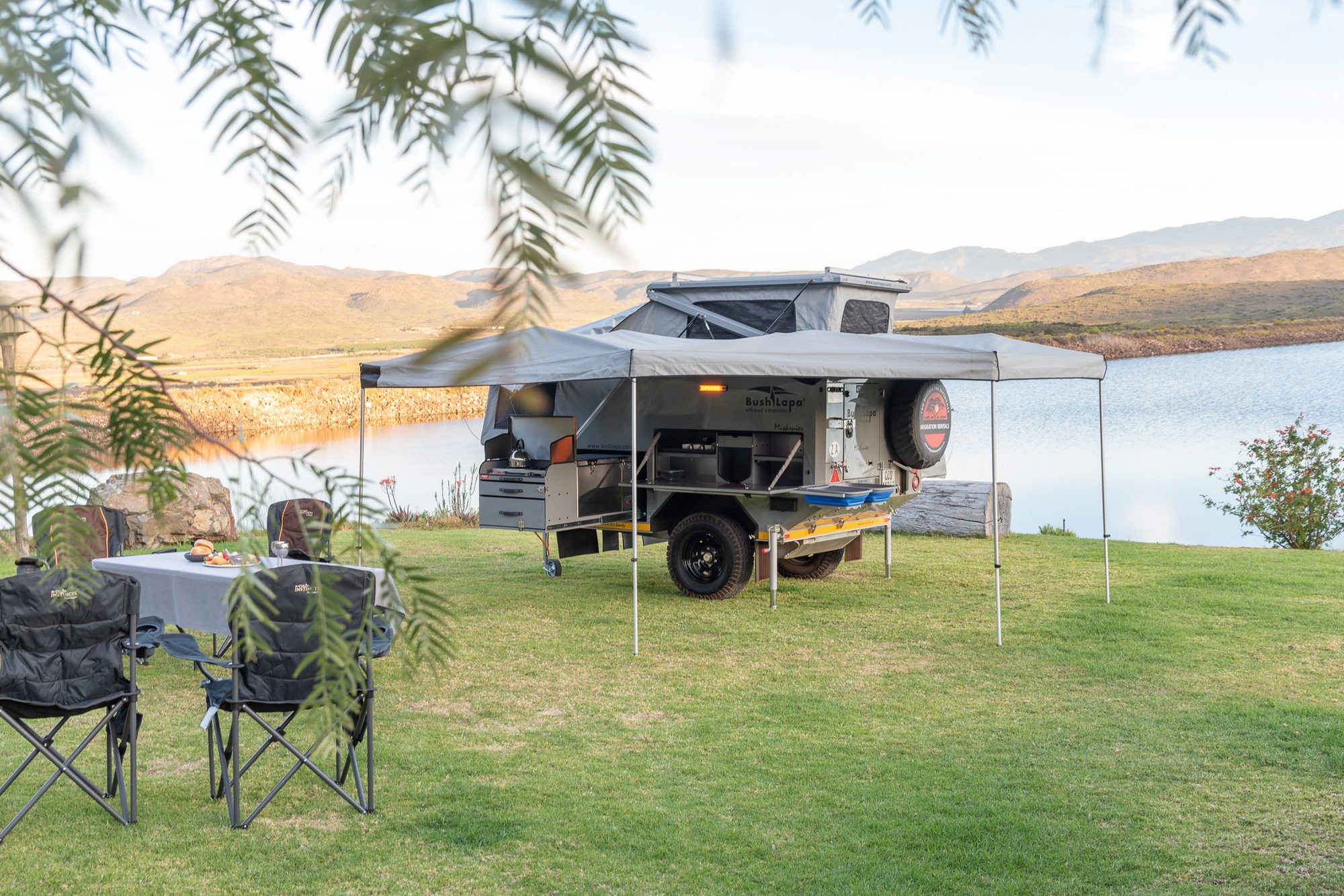
An off-road trailer is a different concept entirely. It is not a caravan that has been made tougher. It is a compact, purpose-built unit on a low chassis with a rooftop tent and a side-room awning, where most of your living happens outside or under canvas. Cooking is done at the trailer's external kitchen. Storage is inside a lockable body. The trailer body itself is not a room you live in.
What you gain: the trailer is short, light (750-1,500 kg loaded in most rental configurations), and follows your 4x4 through the same terrain the vehicle can handle. The 102 off-road trailers on Kampi average R720 a night. Setup takes 5-15 minutes. And when you go on a game drive, you lock the trailer in under five minutes and leave it at camp.
This is the practical difference most first-time renters do not think about until they arrive at Ihaha camp in Chobe and want to drive down to the river at sunset.
A road or off-road caravan set up at camp means the awning is out, the windows may be cracked for ventilation, and the door is probably not secured against a determined baboon. To go on a game drive you either take the whole setup with you (impractical on most game reserve tracks) or leave it in a semi-open state. At many reserves, that is a real risk: monkeys, vervet monkeys, and baboons are documented in forum threads as entering caravans through open windows.
An off-road trailer in camp mode is a rooftop tent folded down, body locked, no exposed openings. Secure in under five minutes. The Tracks4Africa blog puts it plainly: with a trailer, "you needn't pack up your camp every time you go for a game drive and your vehicle will be light and nobody cramped."
This is the question that actually decides the choice. Three scenarios:
A road caravan does this with no drama and more interior comfort than a trailer. Level sites, hookups, tarmac or compacted gravel access. If this describes your trip, the extra cost of an off-road caravan or trailer is a waste of money.
A road caravan will not survive this intact. The only question is whether you want an off-road caravan (more living comfort, heavier tow vehicle required) or an off-road trailer (lighter, more agile, excellent terrain capability, less interior space).
This is where most South African campers actually sit. An off-road caravan is often the best fit: it handles real gravel, sleeps a family properly, and gives you enough interior space that a rainy afternoon does not become a crisis. If your route stays on improved gravel (think the roads into Cederberg established sites, the access track to Anysberg, the N14 to Upington), a gravel-road caravan is a good mid-tier option.
The three questions that resolve most booking decisions:
Who is coming? A couple can sleep comfortably in an off-road trailer rooftop tent. Two couples or a family of four need either an off-road trailer with a side-room tent (which adds to setup time and requires a compatible unit) or an off-road caravan with a proper interior. Road caravans sleep families most comfortably of all, but at the cost of terrain access.
Where are you going? If the answer involves the Kgalagadi, Botswana, Namibia, Mozambique, the Baviaanskloof 4x4 trail, or any route with serious corrugations, you need an off-road unit. If the answer is Kruger, a Klein Karoo resort, or the coastal campsites between Knysna and Plettenberg Bay, a road caravan is fine. If the answer is somewhere in between, a gravel-road caravan or a light off-road caravan is the call.
How long and how remote? A week in the Northern Cape without power hookups is a fundamentally different ask to a long weekend at Bontebok. The longer and more remote the trip, the more the off-road trailer or caravan's self-sufficiency (solar, large water tank, no dependence on level hardstand or hookups) matters.
This is worth checking before you browse listings. South African law ties trailer weight to tow vehicle capability:
Most off-road trailers on Kampi fall in the 750-1,500 kg GVM range. Most off-road caravans are 1,500-3,000+ kg. A well-equipped bakkie (Ranger, Hilux, Fortuner) handles either legally. A smaller SUV or a bakkie on the lower end of tow ratings needs checking before booking a heavy off-road caravan. The EB licence guide covers the legal requirements in detail.
If most of your trip is on tar or well-maintained gravel, with power hookups and level sites: a road caravan gives you the most comfort for the money.
If you are heading into serious gravel, game reserves, or cross-border territory, and your group is a couple or you are comfortable sleeping under canvas: an off-road trailer is lighter to tow, quicker to set up, and the right tool for the terrain.
If you need the terrain capability but also want standing room inside and a permanent bed for children or older travellers: an off-road caravan is the middle ground. Budget for the heavier tow vehicle requirement and the higher rental cost.
386 campers of all types are listed on Kampi right now. Browse by type once you know what the trip demands, and read the listing descriptions carefully: the owner's detail on ground clearance, suspension type, and what terrain they have actually taken the unit to tells you more than the category label alone.
If you are new to renting and still working out whether overlanding is for you, the rent before you buy guide covers what a single trip teaches you about what you actually need. For what to check before departure once you have chosen a unit, the 4x4 camper trip checklist covers the full pre-departure list. And if you are planning a trip with serious power demands (off-grid for several nights), the camper power guide explains how to read the solar and battery specs in a listing before you book.